

Relocating an office is one of the most logistically complex undertakings a business can face. Unlike a household move, an office relocation involves not just furniture and equipment but also servers, data infrastructure, sensitive documents, specialized workstations, and the coordination of dozens or hundreds of employees. The stakes are high — every hour of downtime costs money, disrupts client relationships, and affects employee productivity. With the right planning and an experienced corporate relocation partner, however, an office move can be executed smoothly, efficiently, and with minimal business disruption.
Why Office Relocations Fail: Common Mistakes
Before covering what to do, it is helpful to understand what goes wrong in poorly planned office moves. The most common failures include starting the planning process too late, underestimating the volume of equipment and documents, failing to involve the IT team early, inadequate communication with employees and clients, and choosing a moving company without relevant corporate experience.
Many businesses also make the mistake of treating an office move as a simple logistics exercise rather than a complex project requiring dedicated project management. A successful office relocation benefits enormously from appointing a dedicated internal move coordinator who owns the project timeline and serves as the primary point of contact with the moving company.
1. Start Planning 3–6 Months in Advance
For most office moves, the planning process should begin 3 to 6 months before the intended move date — longer for large enterprises. Begin by creating a detailed project plan with milestones and deadlines. Identify who is responsible for each task: vendor coordination, employee communication, IT migration, furniture planning, address updates, and post-move setup.
Appoint a move project manager within your organization — ideally someone from operations or facilities management with strong organizational skills and the authority to make decisions. This person will be the central coordinator for all move-related activities and the primary contact for your moving company.
2. Conduct a Full Inventory of All Office Assets
Before you can plan a move, you need to know exactly what you are moving. Conduct a comprehensive inventory of all office assets including furniture (desks, chairs, cabinets, shelving), IT equipment (computers, monitors, servers, networking gear, printers, UPS systems), office appliances (coffee machines, refrigerators, microwaves), documents and files, artwork and decor, and any specialized equipment.
Use this inventory exercise as an opportunity to audit your assets. Equipment that is outdated, broken, or no longer needed should be decommissioned rather than moved — this reduces your moving volume and the associated cost. Consider donating functioning equipment to NGOs or recycling electronics responsibly.

IT infrastructure relocation requires specialist expertise to prevent data loss and connectivity disruptions.
3. Prioritize IT Infrastructure Planning
Your IT infrastructure is the backbone of your business. Servers, networking equipment, and data storage systems require specialist handling during relocation — improper disconnection, transit, or reconnection can result in data loss, hardware damage, or extended downtime. Involve your IT team or vendor from the very beginning of the planning process.
Key IT relocation tasks include: creating a comprehensive cable and network diagram before disconnection, labeling every cable, port, and device, taking full data backups before the move, coordinating with internet and phone service providers for connection at the new office, pre-planning the server room layout and power requirements at the new location, and testing all systems before employees arrive.
Consider whether the move represents an opportunity to upgrade your infrastructure or migrate certain services to the cloud. Many businesses use an office relocation as the impetus to move from on-premise servers to cloud-based solutions, which can significantly reduce the complexity of future moves.
4. Plan the New Office Layout in Advance
Before moving day, create a detailed floor plan of your new office showing exactly where every piece of furniture and equipment will go. Share this plan with your moving company so their team knows exactly where to place each item on arrival — this eliminates the need for furniture to be moved multiple times, saves significant time, and reduces the risk of damage.
Use the new space plan to identify any changes to your office setup — new departments, revised team arrangements, updated workstation configurations, or a redesigned server room. If new furniture or partitions are being installed at the new location, ensure installation is complete before your goods arrive. This prevents delay and congestion on moving day.
5. Schedule the Move to Minimize Downtime
Timing is everything in an office move. Whenever possible, schedule the physical move over a weekend or during a holiday period to minimize business disruption. If a weekend move is not feasible, consider a phased move where different departments relocate on different days, ensuring that business operations continue in at least one location throughout the transition.
Communicate the move schedule to all employees well in advance — at least 4 to 6 weeks before the move date. Provide clear instructions on what employees need to pack personally (personal desk items, sensitive documents), what the moving company will handle, and what the timeline is for their area of the office. Clear communication reduces anxiety and ensures everyone is prepared.
6. Handle Documents and Records Securely
Office relocations involve moving potentially sensitive business documents — contracts, financial records, HR files, client data, and legal documents. These must be handled with strict chain-of-custody procedures. Use numbered, sealed document boxes with clear labeling and maintain a detailed inventory of all documents being moved.
This is also an ideal time to assess your document retention policy. Documents that are past their legal retention period should be securely shredded rather than moved. For documents you need to keep, consider whether digitization is an option — scanning and archiving documents can dramatically reduce physical storage requirements at your new office.
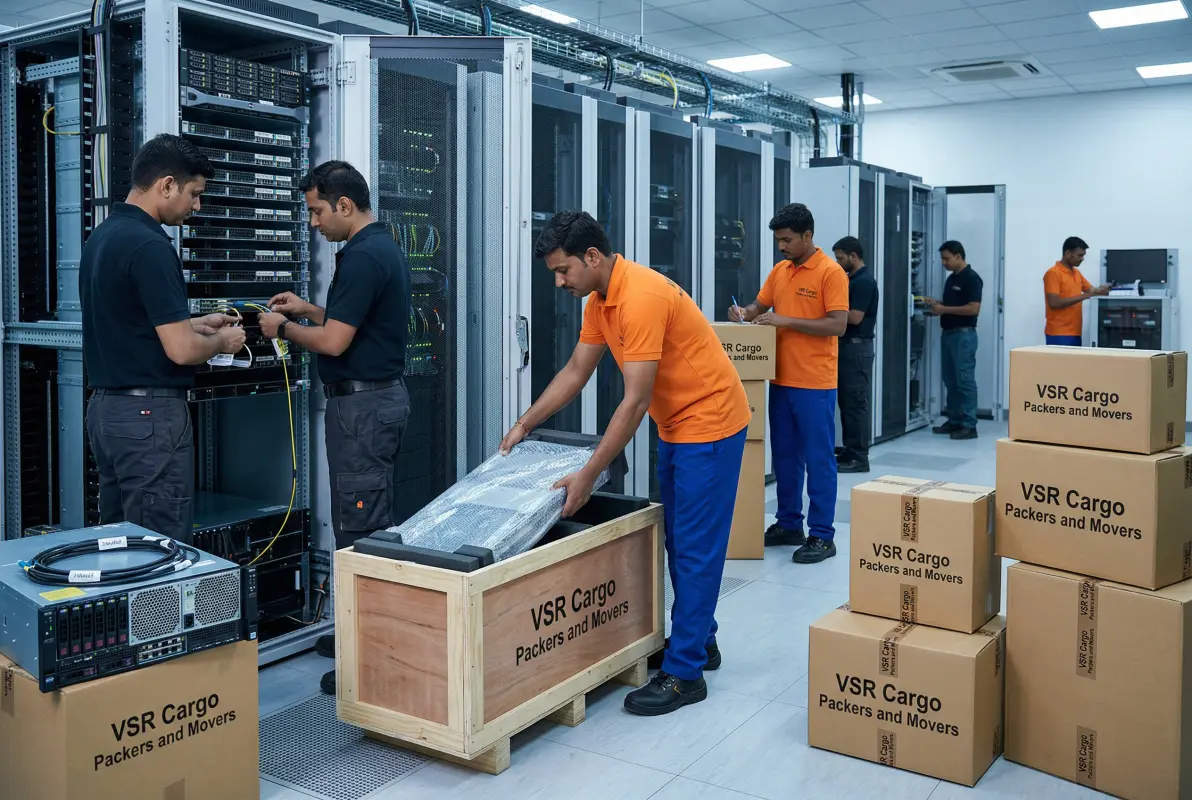
Systematic office packing by trained professionals ensures nothing is misplaced during the move.
7. Update Your Business Address Across All Channels
A comprehensive address update plan is essential for business continuity. The list of entities to notify includes: your website and Google Business profile, social media profiles, business cards and letterheads, your GST registration, bank accounts and payment systems, all vendors and suppliers, all clients (via formal communication), courier and delivery accounts, professional directory listings, and government registrations.
Update your website and Google Business profile as soon as the new address is confirmed — these are often the first places clients look for your location. Send a formal address change notification to clients and business partners at least 2 weeks before the move, and follow up with a reminder on the day of the move.
8. Choose a Corporate-Experienced Moving Company
Not all moving companies are equipped to handle corporate relocations. Office moves require experience with IT equipment handling, document security, large furniture assembly and disassembly, after-hours operations, and coordination with building management at both locations (for freight elevator bookings, service entrance access, parking permits, etc.).
When evaluating corporate moving companies, ask specifically about their experience with office relocations of your size, their IT handling protocols, whether they provide dedicated move supervisors, their insurance coverage for electronic equipment, and their contingency plans for delays or issues. VSR CargoPackers and Movers has extensive experience with corporate relocations, providing dedicated move managers and specialized IT handling teams for office moves of all scales.
Planning an Office Move?
VSR CargoPackers and Movers offers specialized corporate office relocation services with dedicated move managers, IT handling expertise, and 100% insured transit. Minimize downtime and maximize efficiency.
Post-Move: Getting Back to Full Productivity
The move itself is only half the challenge — getting your team settled and productive in the new space is equally important. Arrange for IT systems to be fully tested and operational before employees arrive on their first working day at the new office. Have a designated welcome team or facilities staff available to help employees find their workstations, sort out any setup issues, and answer questions about the new building.
Conduct a walkthrough of the new office with department heads on the morning of the first working day to identify any issues — missing equipment, furniture in the wrong place, connectivity problems — and address them before the broader team arrives. Plan for a brief all-hands meeting to welcome everyone to the new space and communicate key information about the building facilities, parking, emergency exits, and any new amenities.
Gather feedback from employees within the first two weeks — is the seating arrangement working? Are there noise or privacy issues? Is the meeting room configuration adequate? Early feedback allows you to make adjustments before they become entrenched problems.
Conclusion
A successful office relocation is the result of meticulous planning, early preparation, clear communication, and an experienced professional moving team. By following these steps, you can execute your corporate move with minimal downtime, protect your valuable IT infrastructure, and have your team fully operational in their new workspace as quickly as possible.
VSR CargoPackers and Movers has successfully relocated hundreds of corporate offices across India, from small businesses to large enterprises. Our specialized office relocation services include dedicated move planning, IT specialist handling, after-hours operations, and comprehensive insurance coverage. Contact us to discuss your upcoming office move.